
Parents' Column | Activities & parenting
Lessons in the final kindergarten year:
what to choose, and when to start?
“Should we start something before elementary school?” “What should we choose?” The final year of kindergarten (age 5–6) is when many more children start lessons. Why it is an easy time to start, how to choose, when to begin and how many to take, and how to avoid a scramble in the spring of Grade 1 — from our experience in Kodomo School’s classrooms.

Once your child is in the final year of kindergarten, you start hearing that their friends have begun lessons. There is no need to panic and think, “Should we start something too?” — but the final kindergarten year is also just the right time to start a lesson. Here is what we have learned from the many 5- and 6-year-olds in our soroban (Japanese abacus) and calligraphy classrooms.
Why the final kindergarten year is an easy time to start
- They can sit and work for longer
Compared with the year before, children can stay at a desk for longer. This is also when they become able to listen to a teacher and do what they are asked.
- They take an interest in letters and numbers
They want to write their own name, read the clock and the numbers. It is a time when the feelings “I want to know” and “I want to be able to do it” grow.
- They build the habit of “going to lessons” before school
Going on a set day of the week, greeting the teacher, tidying up when finished. This routine, learned through a lesson, is also practice for life at elementary school.
Popular lessons and the skills they build
Lessons for 5- and 6-year-olds fall roughly into the following types. There is no single right answer; we recommend choosing by what you want to nurture.
| Type | Examples | Skills likely to grow |
|---|---|---|
| Sports | Swimming, gymnastics, soccer, dance, etc. | Fitness, body control, working as a team |
| Music | Piano, eurhythmics, etc. | Fingertips, a sense of rhythm, the habit of daily practice |
| Language | English, etc. | Listening skills, interest in other cultures |
| Foundations for learning | Soroban, calligraphy, etc. | Number sense, correct handwriting, concentration at a desk |
| Expression | Drawing, art, crafts, etc. | Thinking for oneself and giving it shape, the joy of expression |
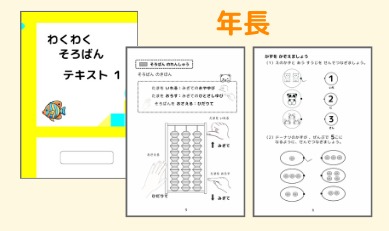
Soroban and calligraphy are often chosen as preparation for elementary school. In Grade 1, children learn hiragana and katakana, and addition and subtraction. Getting a little used to “numbers” and “letters” before school means Grade 1 lessons start from “I understand” and “I can do it.” See also When should a child start soroban? and When should a child start calligraphy (kakikata shodo)?.
Three points for choosing
- Does the child enjoy it?
What matters most is that the child themselves wants to go again. After a trial lesson, watch their face and listen to what they talk about on the way home.
- Does it fit life in Grade 1?
Once school starts, the days and times you can attend change with the end of the school day and after-school care (gakudo) hours. Even when deciding during the kindergarten year, think ahead about how your child will attend once they are in Grade 1.
- Can you keep it up?
Not just the monthly tuition, but the cost over a year, the number of times a week, and the effort of pick-ups. Being able to continue without strain is what builds the most strength. For how to think about costs, see Soroban class tuition: typical fees and what it costs.
When to start? How many?
We recommend starting by about six months before school begins. April of Grade 1 is full of changes for a child: school, after-school care, new friends. Starting a new lesson on top of that makes tiredness build up easily. If your child is already used to a lesson from the kindergarten year, in April the “usual lesson” becomes a reassuring place.
As for how many: start with one, two at most. We recommend leaving some days in the week with nothing on. Adding more once your child has settled in and says they want to do more is the order that lasts longest.
Life in Grade 1 and pick-ups
As the phrase “the first-grade wall” suggests, once school starts children come home earlier than in daycare or kindergarten, and the way pick-ups work changes. When choosing a lesson, it is reassuring to check the following.
- Is the classroom close?: Can your child get there from home, school or after-school care?
- Is there flexibility in timing?: A classroom where children can come any time within a window, rather than only at a fixed time, is easier to fit around after-school care and the end of the school day.
- Rules for absences: Are there make-up lessons when a lesson is missed, and a system for taking a break for a while?
What to look for at a trial lesson
| What to look at | Point |
|---|---|
| Your child’s face | Do they say “that was fun” or “I want to do it again” afterward? |
| How the teacher speaks | Do they notice and praise what the child did well? How do they respond when the child makes a mistake? |
| Length of the lesson | Does it look like your child can sit through the lesson time? If it seems hard, wait about six months and try again |
| Ease of attending | Day, time and place. Can your child still attend once they are in Grade 1? |
| Costs | What is charged besides the monthly tuition (enrollment fee, materials fee, etc.) |
Frequently asked questions
Is it too late if my child has no lessons in the final kindergarten year?
Not at all. Many children start after entering Grade 1. What matters is not when you start, but continuing something that suits your child, without strain.
My child says, “I don’t want to.”
Rather than forcing a start, we recommend just a trial lesson first. Many children change their mind to “that was fun” once they actually try it. If they are still reluctant, try again at a later time.
Which should come first, sports or study?
There is no rule about which comes first. If your child loves moving, start with sports; if they like sitting at a desk, start with soroban or calligraphy. Making “what they like” the entry point for the first lesson makes it easier to keep going.
How much should we prepare for a trial lesson?
Kodomo School’s soroban and calligraphy trial lessons are free (about 20 minutes), and all you need to bring is writing supplies. We provide the soroban at the classroom.
Little by little, from the kindergarten year. As the “I did it!” moments add up, you’ll look forward to elementary school!

About the author
Taito MoritaFounder & principal of Kodomo School (Morita Group Co., Ltd.)
He carries on the Morita Juku founded in Toyohashi in 1972. Through soroban, calligraphy and art at about 90 classrooms in Aichi and Shizuoka and at our Hanoi school in Vietnam, he helps children build the strength to believe in themselves. He also gives talks and seminars on education.
Message from our founderTalks & seminarsUpdated: October 8, 2026
Parents' Column
More reading on activities and parenting
Kodomo School classes
Our 3 classes



Start with a free trial lesson
Soroban and calligraphy trial lessons are free (about 20 minutes; just bring something to write with). The art trial lesson is 40 minutes and costs ¥1,000 (nothing to bring). Come with your child and see the feel of the classroom and how well the teacher suits your child.