
Parents' Column | Soroban
When your child calculates slowly
or makes many mistakes
“Calculation takes forever.” “They understand it, but lose points on careless mistakes.” We hear this often from parents of elementary school children. Here is what we have learned in our classrooms: why calculation becomes slow, the kinds of careless mistakes and how to reduce them, things you can do at home, and what soroban can do.

Slow calculation, many mistakes. In most cases, both are a matter of practice and procedure, not ability. Once you know where the time goes and what kind of mistakes are being made, there is something you can do. If your child has an aversion to math itself, see also Why soroban helps children who struggle with math.
Common reasons calculation is slow
| Cause | What it looks like |
|---|---|
| “How many more to make 10” is shaky | Counts on their fingers for 7+5 |
| Times tables are still uncertain | Stops at 7×8, or starts reciting from the beginning |
| The steps for carrying and borrowing | Goes back and forth between the ones and the tens |
| Writing digits takes time | Writes too carefully, or stroke order and shapes aren’t settled |
| Reading the problem takes time | In word problems, can’t tell what is being asked |
The most common are “how many more to 10” and the times tables. Once these come instantly, all other calculation gets much faster.
Types of careless mistakes and how to reduce them
Just saying “be careful” rarely reduces mistakes. The shortcut is to know what kind of mistake it is and use a fix that matches that mistake.
- Copying errors: Copies the numbers from the problem into the notebook wrongly. → After copying, point with a finger and compare with the problem.
- Digit shapes: 0 and 6, 1 and 7, 4 and 9 look alike. → Decide on a shape for each digit and write neatly.
- Forgetting the carry: Forgets the small “1.” → Decide on a fixed place to write the carry.
- Missing the sign: When addition and subtraction are mixed, misreads the sign. → Mark the signs before calculating.
- Columns slip: In written calculation, the vertical columns drift. → Use grid-ruled paper and line up the place values.
Look back over tests and count how many times the same mistake appears; that shows your child’s habit.
What you can do at home
- The “friends of 10” game: A parent says “7,” the child answers “3.” You can play it in the car or in the bath.
- Times tables out of order: A child may recite them in order but freeze when asked at random. Try asking out of order: “What’s 7×8?”
- Compare times with “yesterday’s self”: “How many seconds faster than yesterday?” keeps motivation going better than comparing with friends.
- Narrow down what to check: Instead of “check everything,” checking only “the copied numbers” and “the answer written down” is easier to keep up and works better.
What soroban can do
- Groups of numbers become visible
On a soroban, the upper bead is 5 and each lower bead is 1. “Groups of 5 and 10” can be seen in the positions of the beads, so “how many more to 10” sinks in through the hands and eyes.
- Columns don’t slip
On a soroban, each rod has a fixed place value. Even with large numbers, it is hard to mix up the places.
- Accuracy builds through checking every time
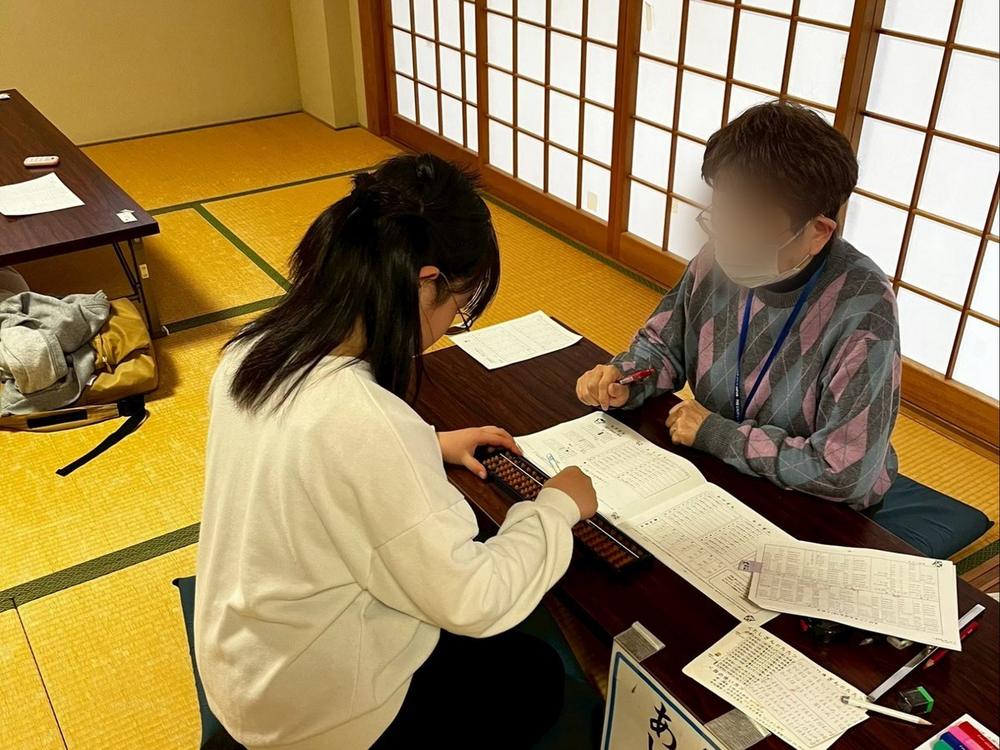
In class, the teacher checks answers on the spot. Mistakes are corrected right away, so the habit of “calculating correctly” takes hold.
- Working within a time limit
Each part of the exam is 15 problems in 7 minutes. The experience of working on problems with the clock in mind pays off in tests, too.
- And then, on to mental math (anzan)
Once the bead movements are second nature, children can calculate by picturing a soroban in their head (How soroban-style mental math works).
Play with a sorobanPractice setting numbers on an on-screen soroban (free for everyone)
What soroban alone can’t do
Soroban is an activity that builds the “foundation of calculation.” Reading word problems, geometry, units and so on are learned through school lessons and homework. When calculation becomes fast and accurate, that much more time is freed up for problems that need thinking.
Frequently asked questions
Is slow calculation a matter of ability?
In most cases it is not ability but practice and procedure. Once “how many more to 10” and the times tables come instantly, calculation gets much faster.
Will careless mistakes go away if my child is more careful?
Just saying “be careful” rarely fixes them. The shortcut is to find which kind of mistake is most common — copying errors, digit shapes and so on — and use a fix that matches that mistake.
If my child learns soroban, will they stop being able to do written calculation at school?
No. Written calculation is learned in school lessons. When number sense and calculation speed develop through soroban, written calculation goes more smoothly as well. We also answer this in Is soroban pointless?.
Can calculation still get faster if my child starts in the upper grades?
Yes. Some students start in the upper grades or in junior high school. With the times tables and carrying already in place, many of them progress quickly.
How long until calculation gets faster?
It differs from person to person. Even with one lesson a week, children gradually become faster and more accurate as they continue. Practicing 5–10 minutes a day at home speeds this up (Soroban practice you can do at home).
Speed comes after accuracy!

About the author
Taito MoritaFounder & principal of Kodomo School (Morita Group Co., Ltd.)
He carries on the Morita Juku founded in Toyohashi in 1972. Through soroban, calligraphy and art at about 90 classrooms in Aichi and Shizuoka and at our Hanoi school in Vietnam, he helps children build the strength to believe in themselves. He also gives talks and seminars on education.
Message from our founderTalks & seminarsUpdated: October 8, 2026
Parents' Column
More about soroban
Find a classroom
Soroban classes in your city

Start with a free trial lesson
Soroban and calligraphy trial lessons are free (about 20 minutes; just bring something to write with). The art trial lesson is 40 minutes and costs ¥1,000 (nothing to bring). Come with your child and see the feel of the classroom and how well the teacher suits your child.