
For elementary school teachers
Soroban in Grade 3 and 4 math:
follow this order and you can teach it
“I never learned soroban myself, so I’m not confident teaching it.” This page is for teachers like you. It brings together 12 free worksheets (with answer keys) you can use in class as they are, plus the key teaching points. It is based on the methods Kodomo School has used for more than 50 years in our soroban classrooms and teacher training. The worksheets (PDF) are in Japanese.
12 worksheets (free)
3 steps × 4 sheets. PDFs with answer keys; print as many copies as your class needs.
Teaching points
The parts of the soroban, finger use, chants, where children stumble and what to say. Five minutes to read before class.
On-screen soroban
We also have a free touch-and-move soroban you can show on an interactive whiteboard or tablet.
In the national Course of Study
What Grade 3 and Grade 4 learn
In the math section of Japan’s Course of Study for elementary schools (2017 edition), children learn to represent numbers and calculate with a soroban in Grade 3 and Grade 4.
| Grade | Main content | Examples |
|---|---|---|
| Grade 3 | Representing numbers on the soroban. Simple addition and subtraction (including numbers in the ten-thousands and decimals to the tenths place) | Set 257; 3 + 4; 9 + 6; 13 − 6; 20,000 + 60,000; 7.2 − 3.4 |
| Grade 4 | Addition and subtraction on the soroban (large numbers in the hundred millions and trillions, and decimals) | 300 million + 500 million; 800 million − 240 million; 1.23 + 2.4; 6.05 − 2.38 |
In the textbooks, both grades cover this as a short unit of a few lessons. The goal is not to turn children into soroban experts. It is to let them see place value with their own eyes, and to think in groups of 5 and 10. Even if you have never learned soroban yourself, work through the worksheets below in order and your class will be calculating well.
Free worksheets
12 worksheets,
ready to use in class
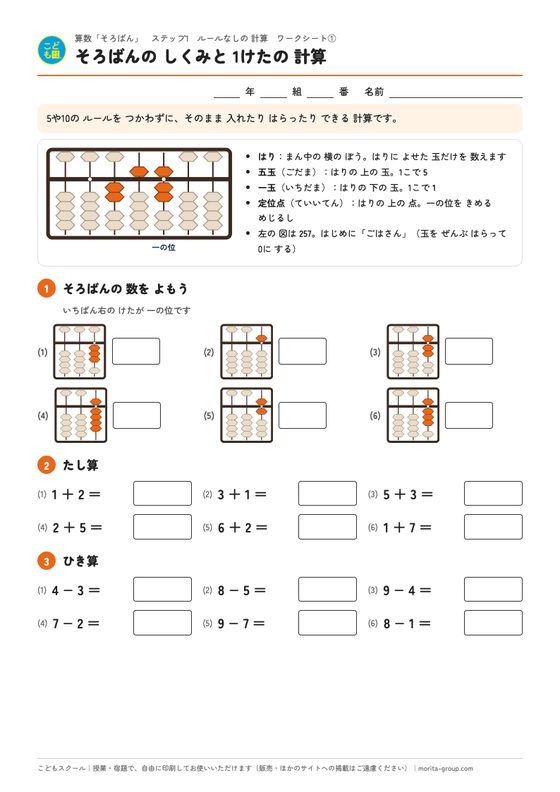
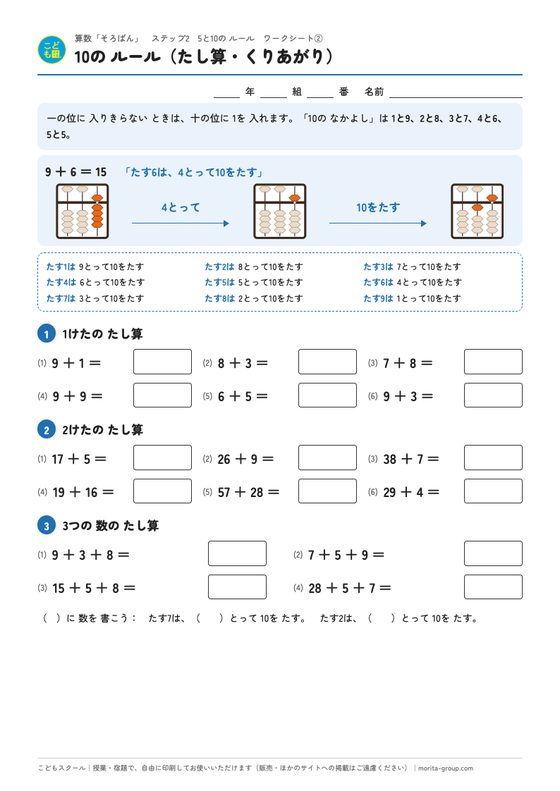
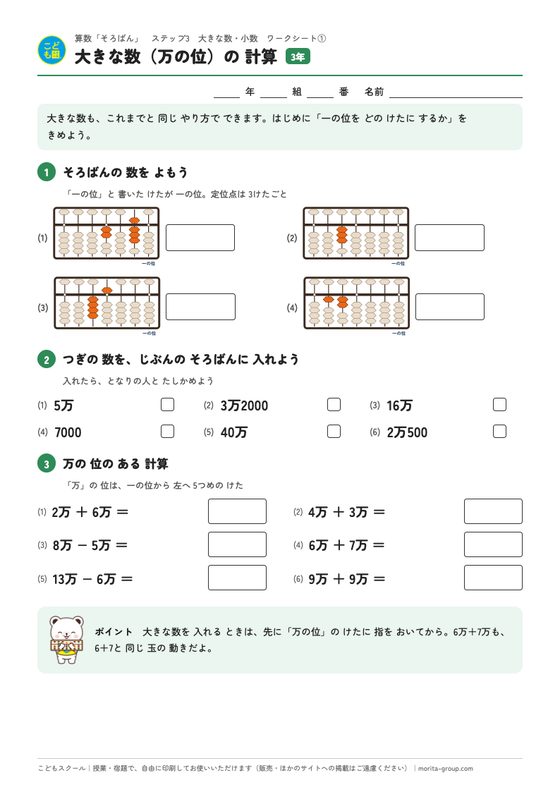
Three steps × 4 sheets, from easiest to hardest. In every PDF, the last page is the answer key for the teacher. Print freely for lessons and homework.
Before class
The basics every teacher should know
| Term | Meaning |
|---|---|
| Beam (hari) | The horizontal bar across the middle. Only beads pushed against the beam count. |
| Five-bead (godama) | The bead above the beam. One bead = 5 |
| One-beads (ichidama) | The beads below the beam (4 of them). One bead = 1 |
| Unit point (teiiten) | The dots on the beam. The marker for deciding which rod is the ones place. There is one every 3 rods, so they also mark the thousands, millions and billions places |
| Set / clear | Pushing a bead to the beam is “setting” (ireru); moving it away from the beam is “clearing” (harau) |
| Gohasan | Clearing every bead so the soroban reads 0. Always do this before calculating |
Textbooks word these terms slightly differently, for example 五珠 / 一珠 or 五だま / 一だま for the five-bead and one-beads. Follow the textbook you use.
Finger use
Setting a one-bead (pushing it up) = thumb. Clearing a one-bead (pushing it down) = index finger. The five-bead is both set and cleared with the index finger.
Placing the soroban
Lay it straight on the desk and hold the left end lightly with your left hand. Begin with “gohasan.”
Setting numbers
Decide which rod with a unit point is the ones place, then set the digits from the largest place down.
The 5 and 10 rules
Chants to say out loud and remember
When there are not enough one-beads, use the five-bead; when a number will not fit on the ones rod, use the next rod over. Putting the steps into words and chanting them while moving the beads keeps children from getting lost.
| Rule | Chant (example) |
|---|---|
| 5 rule (addition) | To add 4: add 5, take away 1 3 + 4 = 7 |
| 5 rule (subtraction) | To subtract 4: add 1, take away 5 7 − 4 = 3 |
| 10 rule (addition) | To add 6: take away 4, add 10 9 + 6 = 15 |
| 10 rule (subtraction) | To subtract 4: take away 10, add 6 12 − 4 = 8 |
| Both 5 and 10 | To add 6: add 1, take away 5, add 10 7 + 6 = 13 To subtract 6: take away 10, add 5, take away 1 13 − 6 = 7 |
At Kodomo School we call these the “addition and subtraction chants” (tashizan no kuku, hikizan no kuku), and children learn them out loud, the way they learn their times tables. Step 2 of the worksheets has a complete list of the chants. Textbooks may word them a little differently, but the bead moves are the same.
Sample lesson plan
3 lessons for Grade 3, 2 for Grade 4
There are 12 worksheets in all; 1–2 sheets per lesson is a good pace. You do not have to use them all. Choose what fits your school’s and textbook’s plan, and keep the rest for early finishers or homework.
Grade 3
- Lesson 1: How the soroban works, and calculation without rules (Step 1 ①②)
Parts of the soroban → gohasan → setting and reading 1-digit numbers → 1- and 2-digit addition and subtraction. Children pair up and read each other’s numbers. Use ③④ for practice or homework.
- Lesson 2: The 5 and 10 rules (Step 2 ①②)
First, say the friends of 5 (1 and 4, 2 and 3) and the friends of 10 (1 and 9 … 5 and 5) out loud together. Then the whole class works 3 + 4 and 9 + 6, chanting as they move the beads. Keep ③ subtraction and ④ problems that use both rules for the start of the next lesson or for homework.
- Lesson 3: Large numbers and decimals (Step 3 ①②)
Help children notice that 20,000 + 60,000 and 7.2 − 3.4 work exactly the same way as before, once they decide where the ones place is. Finish by talking together about what is good about the soroban.
Grade 4
- Lesson 1: Grade 3 review, plus hundred millions and trillions (Step 3 ③)
Spend the first 10 minutes reviewing with one sheet from Step 1 or 2. Then, using the fact that unit points come every 3 rods, have children find the hundred-millions and trillions places with a finger before they calculate.
- Lesson 2: Decimals (Step 3 ④)
Put the ones place on a unit point; the rod to its right is the tenths place, and the next one the hundredths place. Line up the decimal points when setting the numbers, and the calculation works just like whole numbers.
Teaching points
Common stumbles and what to say
Losing track of the ones place
The most common stumble. Before each calculation, have everyone point: “Where is the ones place?” Having children hold the ones rod with a left-hand finger while they calculate cuts mistakes dramatically.
Stuck on calculations that use the five-bead
First say the friends of 5 (1 and 4, 2 and 3) out loud. Then move the beads while chanting “To add 4: add 5, take away 1” (Step 2 ①).
Stuck on calculations that use 10
Check the friends of 10 (1 and 9, 2 and 8 … 5 and 5) first. Then “To add 6: take away 4, add 10,” and for subtraction “To subtract 4: take away 10, add 6.” Problems that use both 5 and 10, like 7 + 6 and 13 − 6, are the hardest part (Step 2 ④).
Beads not pushed all the way to the beam
Beads left halfway get misread. Say “Snug against the beam!” and “Cleared beads all the way down!”
Inconsistent finger use
Go over it carefully once at the start. In a unit of only a few lessons there is no need to be strict; it is fine to put getting the right answer first.
Fast finishers and slower children
Fast finishers can try the remaining worksheets or our free soroban practice sheets. Slower children can go back to Step 1, or work in pairs, taking turns as “reader” and “setter.”

The best thing about the soroban is that you can see place value with your own eyes!
For use in class
On-screen soroban, practice sheets and videos
Touchable soroban (free)Show it on an interactive whiteboard or tablet so the whole class can practice setting the same number
Soroban practice sheets (free)10th to 4th kyu, with answers. For children who want more practice
 Soroban demonstration videosHand movements for carrying and borrowing with 5 and 10
FAQ
Questions from teachers
Can I teach this if I have never learned soroban?
Yes. Grades 3 and 4 cover only how to represent numbers and the basics of addition and subtraction. Work through the worksheets in order, Step 1 → 2 → 3, saying the chants out loud, and you will be fine. Before class, try the worksheets yourself once.
Do I have to use all the worksheets?
No. Choose according to your class time and how the children are doing. We suggest centering lessons on Step 1 ①②, Step 2 ①② and Step 3, and using the rest for practice or homework.
May I print a copy for every child?
Yes. Print freely for lessons and homework. We only ask that you do not sell them or post them on other websites.
Where are the answers?
The last page of each PDF is the answer key for the teacher. The “Set the number” problems are for children to check with a partner, so no answers are given for them.
Our school does not have enough sorobans for everyone.
Have two children share one, taking turns as “setter” and “reader”; it actually sparks more discussion. You can also use the on-screen touchable soroban on tablets.
What about left-handed children?
The soroban is usually worked with the right hand, but in a short unit, put understanding how numbers work first. Rather than forcing everyone to use the same fingers, make enjoying the calculation the priority.
The terms differ from my textbook (五珠, 一珠, etc.).
Textbooks word things slightly differently. Use the terms from your own textbook with the children. The content of the worksheets (how to set numbers and move the beads) is the same.
The school behind this page
About Kodomo School
Founded in Toyohashi in 1972, we run soroban, Japanese calligraphy & handwriting and art classes across Aichi and Shizuoka. The teaching methods on this page are based on what we use in our own teacher training.