
Parents' Column | Soroban
Soroban grade exams: the kyu levels and how to take them
Which kyu is typical for elementary students?
“Which kyu do you start the exams from?” “How long does it take to pass?” “What is exam day like?” Soroban grade exams are the best chance for children to see their progress and build confidence. What each kyu covers, the pass mark, when and how the exams are held, and what you can do at home — based on Kodomo School’s exams.
Once a child starts learning soroban (the Japanese abacus), the first goal is the “grade exam” (kentei). The kyu levels go up one small step at a time, so small “I did it!” moments pile up in a visible form — one of the great things about soroban. The face of a child bringing home a certificate is truly happy.
What soroban grade exams are
Soroban grade exams (shuzan kentei) are run by several organizations. The best known are the abacus proficiency exams of the Japan Chamber of Commerce and Industry and the Japan Soroban Federation (Nihon Shuzan Renmei). The smaller the kyu number, the higher the level: the numbers have more digits, and you also need the speed to finish within the time limit.
Kodomo School’s exams are certified by the Association for the Promotion of Traditional Education in Local Communities (a general incorporated association). Children who pass receive a certificate in the association’s name. The subjects are the same as in most soroban exams: mitorizan (addition and subtraction), multiplication and division.
What each kyu covers (10th to 3rd kyu)
| Kyu | Mitorizan (addition & subtraction) | Multiplication | Division |
|---|---|---|---|
| 10th kyu | 1-digit numbers, 6 rows / 1- or 2-digit numbers, 4 rows | — | — |
| 9th kyu | 1- or 2-digit numbers, 5 rows | 2 digits × 1 digit | — |
| 8th kyu | 2-digit numbers, 8 rows | 3 digits × 1 digit | 2–3 digits ÷ 1 digit |
| 7th kyu | 2- or 3-digit numbers, 5 rows | 2 digits × 2 digits | 3–4 digits ÷ 1 digit |
| 6th kyu | 3-digit numbers, 7 rows | 3 digits × 2 digits, etc. | 3–4 digits ÷ 2 digits |
| 5th kyu | 4-digit numbers, 7 rows | 3 digits × 3 digits, etc. | 5 digits ÷ 3 digits, etc. |
| 4th kyu | 5-digit numbers, 7 rows | 7 digits in total | 6 digits ÷ 4 digits, etc. |
| 3rd kyu | 5-digit numbers, 8 rows | Includes decimals | Includes decimals |
“Rows” (dan) means the number of numbers added or subtracted in a mitorizan problem (the number of lines). For example, “1-digit numbers, 6 rows” means adding six 1-digit numbers one after another. Please ask at the classroom about the levels above 3rd kyu.
Multiplication is added from 9th kyu and division from 8th kyu, so all three subjects come together at 8th kyu. Above 6th kyu, no new ways of calculating appear; instead the numbers get longer and speed is required. You can see the problems for each kyu in our free practice sheets.
The pass mark
- At every kyu, each subject has 15 problems, 150 points in total, and a time limit of 7 minutes.
- 10 or more correct out of 15 (100 points or more) passes.
- At levels with two or three subjects, 100 points or more in every subject is required.
Two-thirds correct is a pass, so your child doesn’t need to get everything right. Rather than rushing to answer every problem, solving one problem at a time, accurately is the surer way to pass.
Which kyu is typical for elementary students?
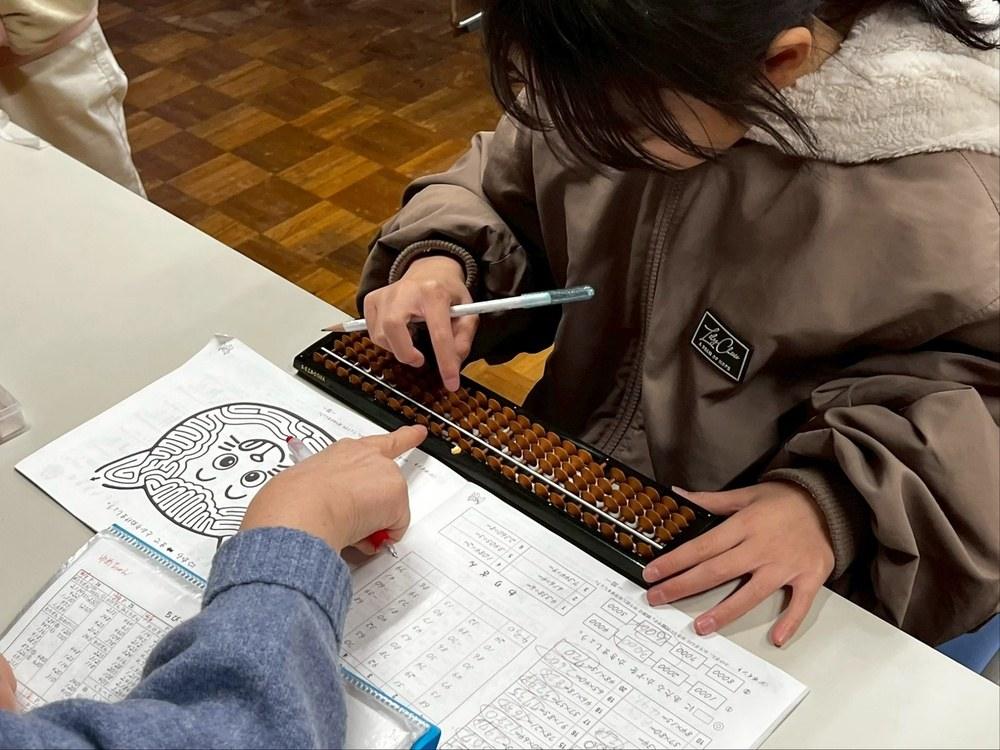
There is no rule like “this grade, this kyu.” It depends on the age your child started and how long they have attended. With Kodomo School’s once-a-week lessons, the rough guide is as follows.
- The first exam: Once the basics of mitorizan are in place, your child can take 10th kyu. Many elementary students try their first kyu after six months to a year of lessons.
- Many start from 8th kyu: Many children begin taking exams at 8th kyu, where all three subjects — mitorizan, multiplication and division — come together.
- Faster children reach 8th or 7th kyu in about a year and a half: It varies from child to child. From 7th kyu, the speed to finish within the time limit is also needed.
In general, many people aim for 3rd kyu or higher in soroban exams, and it is a level many people put on their résumé. Kodomo School’s soroban teachers are also required to hold “3rd kyu or higher in the soroban grade exams.”
Exam day, step by step
Kodomo School’s exams are held four times a year (March, June, September and December) in the classroom your child usually attends. There is no need to go to an unfamiliar venue, so even small children can take them with peace of mind. It is the usual classroom, but at exam time we deliberately create a different, slightly tense atmosphere.
- Write your full name on the front of the problem sheet, then turn it face down.
- Place the soroban on your left, with your hands on your knees.
- On “Ready,” turn the sheet face up; on “Begin,” start.
- On “Stop,” put down the soroban and pencil, even in the middle of a calculation.
How answers are written also affects the result. Write the digits neatly; writing over a digit twice, or a digit that could be mistaken for another, counts as wrong. Don’t use an eraser; cross out a wrong answer with two lines and write it again. We practice the exam procedure in class, too.
What you can do at home
- Practice with the free practice sheets: Anyone can download our soroban practice sheets (10th to 4th kyu, three sets per kyu, with answers), in the same format as Kodomo School’s exams.
- Practice writing digits neatly: Being able to write easily confused digits — 0 and 6, 1 and 7, 4 and 9 — so they are clearly different changes the score by itself.
- Try solving against the clock: From 7th kyu, speed matters too. Time your child on the problems they bring home from class.
- Praise the effort, not the result: Especially after a fail, put what they can now do into words: “Look how far you’ve come.”
Frequently asked questions
What happens if my child fails?
They can take the exam again at the next round. Exams are held four times a year, so they can try again three months later. The teacher goes over where the mistakes were, and your child practices for the next round.
Does my child have to take the exams?
No, they are not compulsory. But having a goal helps children work more seriously in everyday lessons, too. Whether to take an exam, and which kyu, is decided together by the teacher and the family.
How do we apply, and what is the exam fee?
Once the kyu is decided, the classroom teacher will explain how to apply and the exam fee.
How are these different from other organizations’ exams?
The certifying body is different. The subjects are the same as in most soroban exams: mitorizan, multiplication and division. What is special about Kodomo School’s exams is that children take them in their usual classroom, with a teacher they know.
10 out of 15 and you pass! Take it one problem at a time, carefully.

About the author
Taito MoritaFounder & principal of Kodomo School (Morita Group Co., Ltd.)
He carries on the Morita Juku founded in Toyohashi in 1972. Through soroban, calligraphy and art at about 90 classrooms in Aichi and Shizuoka and at our Hanoi school in Vietnam, he helps children build the strength to believe in themselves. He also gives talks and seminars on education.
Message from our founderTalks & seminarsUpdated: October 12, 2026
Parents' Column
More about soroban
Find a classroom
Soroban classes in your city

Start with a free trial lesson
Soroban and calligraphy trial lessons are free (about 20 minutes; just bring something to write with). The art trial lesson is 40 minutes and costs ¥1,000 (nothing to bring). Come with your child and see the feel of the classroom and how well the teacher suits your child.