In short
- Shodo (書道) means “the way of writing”: Japanese characters written with a soft brush, black ink, and thin paper.
- A brush records every movement of your hand, and there is no eraser. If a character goes wrong, you take a new sheet.
- Teachers look at three things: the stroke, the order, and the balance. None of them requires talent, only attention.
Two characters, one word
Writing書sho
The first character means “to write” or “writing.”
Way道do
The second means “way” or “path,” the same do you find in judo, kendo, and sado, the way of tea.
In Japan, a “way” is something you follow for a long time. It has basic forms that everyone learns, a tradition of teachers and students, and the idea that practice shapes not only your skill but also your attention and your character. So shodo is also a way of slowing down and paying attention to one thing at a time.
How brush writing traveled from China to Japan and became an art of its own is the story of the next lesson.
Writing with a brush
A brush behaves very differently from a pen.
Press and lift
Press a little harder and the line becomes thicker. Lift slightly and it thins out.
Slow and fast
Move slowly and the ink soaks into the paper. Move quickly and the line may show white streaks where the brush ran dry.
Every stroke records exactly how your hand moved, how fast, and how firmly. A piece of calligraphy is a record of a moment.
There is no eraser and no going back. Once the brush has touched the paper, the stroke is finished. If you are not happy with a character, you take a new sheet and write it again.
Shuji and shodo
Japanese people use two words that are close to each other.
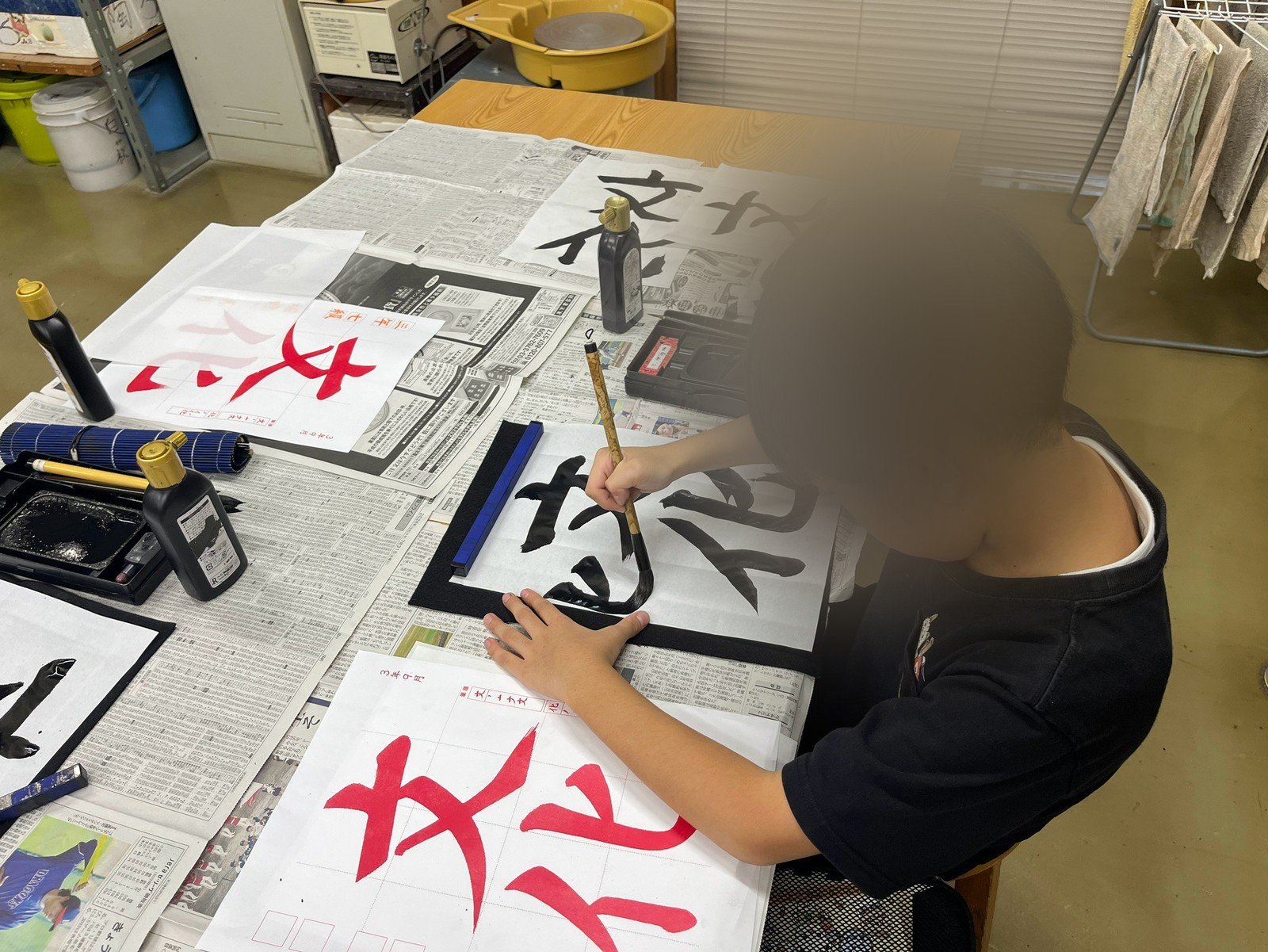
Shuji習字learning to write characters
Writing neat, correct, balanced characters by copying a model.
Japanese children study it at school, usually from the third grade of elementary school, and many also attend weekly after-school classes like ours, with tests to move up in rank.
Shodo書道the way of writing
All of that, and further: beyond neat handwriting, an art form.
Adult calligraphers write poems, single characters, and phrases that express a feeling, shown in exhibitions and hung in homes, temples, and restaurants. Some is so free that people who cannot read Japanese enjoy it as abstract art.
These lessons start where every Japanese student starts: with shuji, the careful copying of a model in a clear, upright script called kaisho. That foundation is what makes expressive work possible later on. To see a lesson, read how children learn calligraphy in Japan.
Where you see shodo in Japan
New Year書き初めkakizome
At the start of the year, many people do kakizome, “the first writing of the year,” writing a word or phrase that expresses a hope for the year ahead.
School
Children’s brush writing is often displayed on classroom walls, and many schools hold a kakizome event in January.
Everyday life
Shop signs, restaurant menus, sake labels, festival banners, and the titles of movies and TV dramas are often written with a brush, because brush writing feels warm, traditional, and strong.
Temples and shrines御朱印goshuin
Visitors can collect goshuin, stamps and brush-written inscriptions in a special book, as a record of their visit.
For more occasions, see when Japanese people write with a brush.
The three things teachers look at
When our teachers look at a student’s work, they mostly look at three things.
- The stroke
Does each line begin firmly, travel smoothly, and end in the right way? See the strokes.
- The order
Are the strokes written in the correct order and direction? The order affects how the character flows and how balanced it looks.
- The balance
Are the parts of the character the right size, and is the character placed well on the paper?
Why people practice it
People come to shodo for many reasons: a love of Japanese culture, a quiet hobby away from screens, or the characters they see in anime, on travel posters, or on a favorite tea cup.
Shodo is an art and a hobby, not a treatment. These are the things many practitioners describe, and what we see in our classrooms. Everyone’s experience is different.
- A time to focus on one thing. While you write a stroke, you cannot think about much else, and many people say twenty minutes of writing leaves them calm and refreshed, a little like meditation.
- Slower breathing and a steadier body. Sitting upright and breathing out slowly as you write a long stroke is said to help people feel relaxed and grounded.
- Patience, and a kind attitude toward mistakes. You will write many sheets you are not happy with, even as a teacher, and shodo teaches you to look at the mistake, understand it, and try again on a fresh sheet.
- Seeing more carefully. Copying a model trains your eyes to notice the angle of a stroke, the space between lines, and the balance between the parts of a character.
- A window into Japanese culture. Words calligraphers like to write, such as peace, gratitude, and harmony, reflect values important in Japanese culture, and writing them is a way of thinking about them.
- Something beautiful that you made by hand. A word you wrote yourself can be framed, given as a gift, or hung on the wall, which feels special when most writing happens on a keyboard.
Questions
What does shodo mean?
Shodo (書道) is made of two characters: sho (書), “to write,” and do (道), “way,” the same do as in judo and kendo. So shodo is “the way of writing,” something you follow for a long time.
What is the difference between shuji and shodo?
Shuji (習字) is learning to write neat, correct, balanced characters by copying a model, as Japanese children do at school. Shodo (書道) includes shuji and goes further, into an art form that expresses a feeling.
Do you need talent to learn Japanese calligraphy?
No. The stroke, the order, and the balance require attention, not talent, and attention can be practiced. You do not need to read Japanese, either: if you can hold a pencil and sit quietly for twenty minutes, you can begin.