In short
- Most line problems come from the ink: too much makes fuzzy blots, too little makes white streaks.
- Wobbles, round beginnings, and blunt endings come from the hold and the movement, not the ink.
- Change only one thing at a time, so you can tell what helped.
Ink: too wet or too dry
Fuzzy, blotted lines
The ink spreads and makes fuzzy, blotted lines. There is usually too much ink on the brush, or you are moving too slowly.
Adjust the ink on the land of the inkstone before each character, and keep the brush moving at a steady pace. Check that you are writing on the smooth side of the hanshi. See Ink and loading the brush.
Scratchy lines with white streaks
The lines are scratchy and show white streaks. The brush is running out of ink, or you are moving too fast.
Reload more often, and slow down a little, especially on long strokes. Some streaks at the end of a sweep are natural, but streaks in the middle of a short stroke mean the brush is too dry.
Strokes: wobbles, beginnings, and endings
Wobbly, shaky lines
The lines wobble and shake. This is very common at first.
Check that you are holding the handle around the middle, that your elbow is off the table, and that the movement comes from your arm. Breathe out slowly as you write the stroke. Wobbles get much better with a few weeks of line practice. See Posture and grip.
Round beginnings
The stroke starts round, not angled. The brush is probably coming straight down, or being dragged in from the side.
For a horizontal stroke, let the tip land at about a 45-degree angle toward the lower right, press, and then move to the right. See The strokes.
Blunt endings on sweeps
The sweeps end in a blunt stump. The brush is stopping before it lifts.
In a sweep, keep moving while you lift, so that the brush leaves the paper in motion. Practice rows of sweeps on scrap paper, saying to yourself “move, move, lift.”
Layout on the sheet
Too small, or too close to the edge
Most beginners write too small, or too close to the edge.
Fold the paper into guide lines, and look at the whole sheet before you begin. Write as if each character should fill its half of the sheet, leaving margins all around. See Writing on hanshi.
The two characters do not match
The two characters do not look like a pair.
Check that both are centered on the same vertical line, and that they look the same size. A character with many strokes needs to be written a little larger, and a simple character a little smaller.
Brush and paper
Split brush hair
The brush hair splits into several points.
Reload the brush and reshape the tip on the land of the inkstone. If it happens even with a fresh load, the brush may not have been loosened fully, or ink may have dried near the root. Wash the brush thoroughly after use. See Caring for your tools.
Wrinkled paper
The paper wrinkles or sticks to the pad when there is a lot of ink. It is normal.
Lift the finished sheet carefully from one corner and let it dry flat. Using a little less ink will reduce wrinkles.
When you feel stuck
Not improving
Improvement in shodo comes in steps, with flat periods in between.
Keep your sheets with dates on them, and compare work from a month ago with today’s. If you can, find a teacher or a class to look at your work. A teacher’s red marks can show you in seconds what is hard to see on your own. See Next steps.
Being your own teacher
In Japan, the teacher corrects the student’s sheet in red. If you are learning on your own, you can borrow this method.
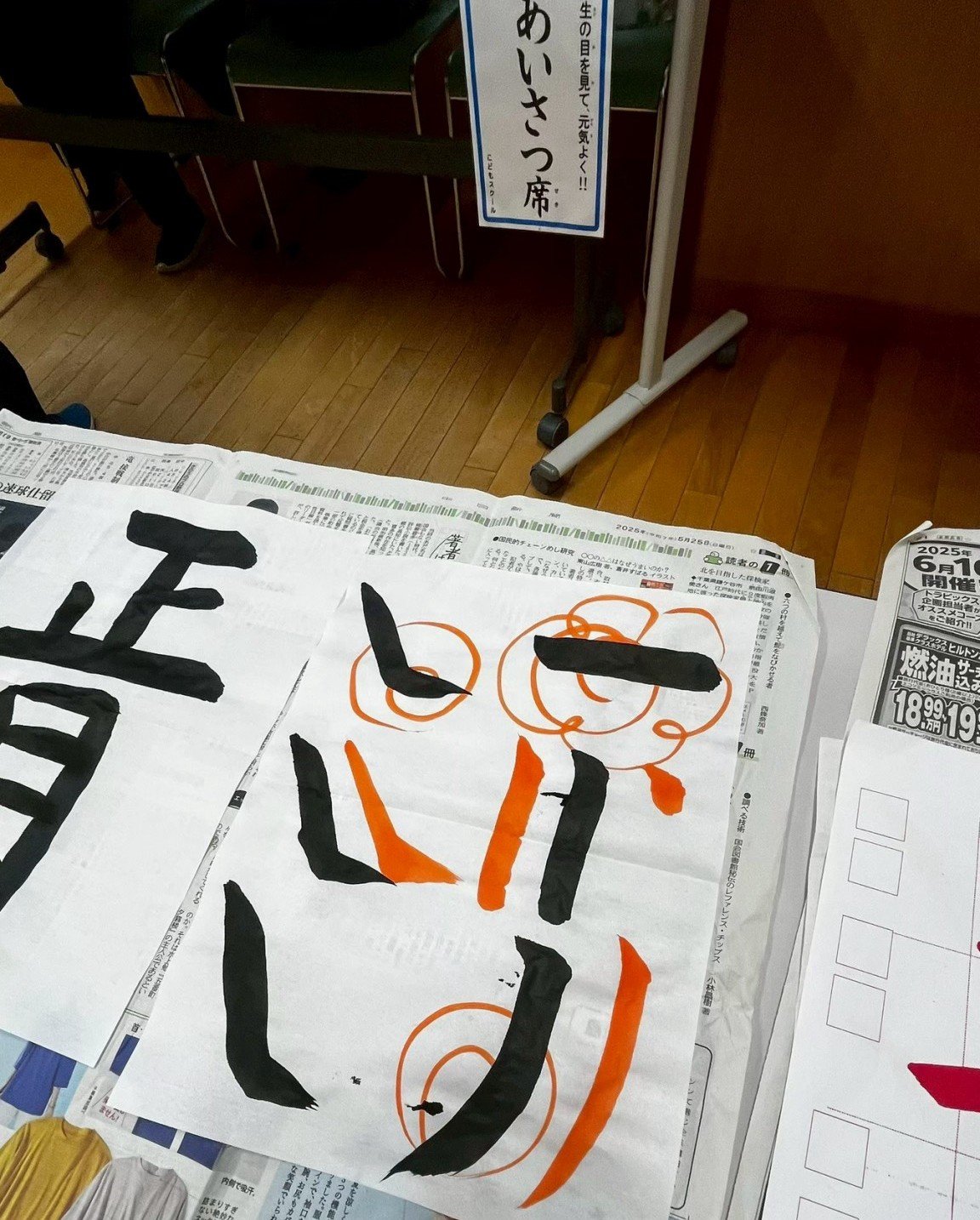
- Let the sheet dry, then lay it next to the model.
- Mark one or two things in red that differ most from the model: a stroke that is too short, an ending that is wrong, a part that is too big. Use a red pencil or pen.
- Write the next sheet with only those points in mind. It is surprisingly effective.
- Try a photo. Your sheet on a screen, next to a photo of the model, can show the differences more clearly.
Try it now
One sheet, one red mark, one more sheet.
Print the sheet for 花火 (hanabi, fireworks). Write it once, let it dry, and mark in red the one thing that differs most from the model. Then write it again.
Questions
Why is my calligraphy brush splitting?
Reload the brush and reshape the tip on the land of the inkstone. If it still splits with a fresh load, the brush may not have been loosened fully, or ink may have dried near the root.
Why does my ink bleed on the paper?
Usually there is too much ink on the brush, or you are moving too slowly. Adjust the ink on the land of the inkstone before each character, and keep a steady pace.
How long does it take to get better at Japanese calligraphy?
Wobbly lines usually improve within a few weeks of line practice. After that, improvement comes in steps with flat periods in between. Date your sheets and compare month to month.