In short
- Choose mixed hair, or “medium” firmness, about 1/2 inch thick and 2 inches long. “For hanshi” or “for students” on the label is usually right.
- A reliable student brush is much better than a beautiful but very soft brush made for advanced work.
- Before the first use: throw away the plastic cap, loosen the hair gently from the tip, and rinse in lukewarm water.
The parts of a brush
The brush is the most personal of the four treasures. Calligraphers often own many, each for a different purpose.
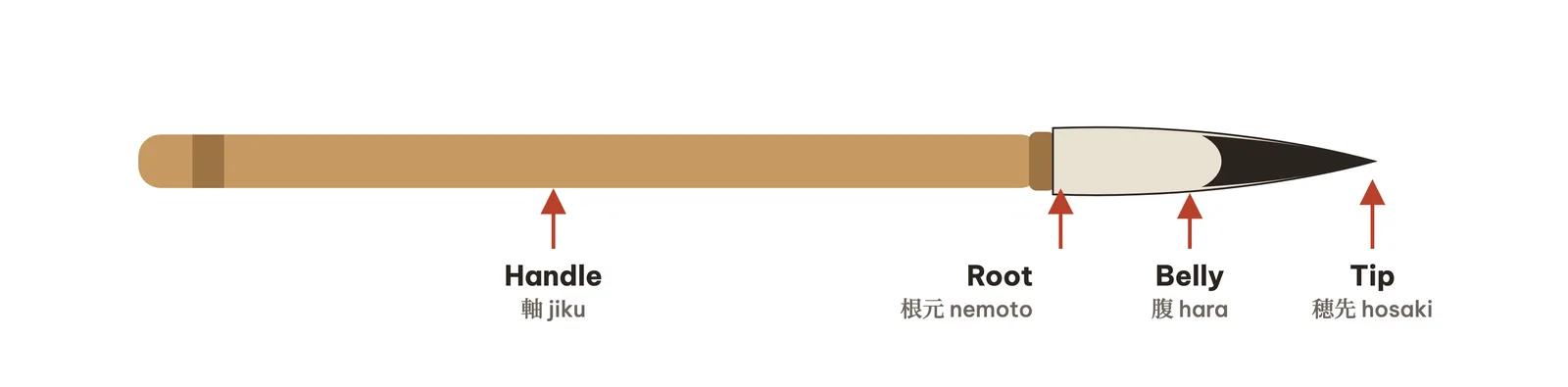
- The tip (hosaki, 穂先) is the fine point at the end of the hair. Most of the time, it does the writing.
- The belly (hara, 腹) is the fuller middle part. It holds ink and makes thick lines when you press.
- The root (nemoto, 根元) is where the hair meets the handle.
- The handle (jiku, 軸) is usually bamboo or wood.
Hair type: soft, firm, or mixed
Brushes are made from many kinds of animal hair, and each kind feels different.
Soft: goat hair羊毛yomo
Often sold as “sheep hair.” Soft, and holds a lot of ink, so it makes rich, expressive lines.
But it bends easily, so it is harder to control at first.
Firm: horse or weasel hair馬毛・イタチbamo, itachi
Firmer and springier. The brush snaps back into shape after each stroke, which makes control easier.
Mixed hair (kengo, 兼毫) combines a soft hair with a firm one, for a balance of control and ink-holding. Many brushes sold for students are made this way.
Size: one large, one small
Large brush太筆futofude
For two characters on a sheet of hanshi, the size most students use: a hair bundle roughly 1/2 inch (12 to 14 millimeters) thick and about 2 inches (5 centimeters) long.
Japanese size numbers (go, 号) differ from maker to maker, so look at the measurements.
Small brush小筆kofude
For signing your name: a hair bundle about 1/4 inch (5 to 7 millimeters) thick. You can add this one later.
How to tell a good brush
- A clear point. Wet and pressed into shape, the hair comes to a single, sharp tip, not a split or ragged end.
- Even hair. The bundle is round and full, not lopsided.
- A firm root. The hair does not wobble in the handle or shed many hairs after the first few washes. A few loose hairs at first is normal.
You do not need an expensive brush to start. Our school, Kodomo School, is in Toyohashi; you can read about brushes made in Toyohashi on this site.
Preparing a new brush
A new brush arrives with its hair stiffened by a light glue (starch) that protects the shape, often with a clear plastic cap.
- Throw away the plastic cap
It is only for shipping. Put back on a wet brush, it can make the hair bend, rot, or grow mold.
- Loosen the hair gently with your fingers
From the tip, press and roll the hair softly between your fingertips to break up the glue, little by little toward the root. For a large brush, loosen all the way to the root; for a small name brush, only the front third.
- Rinse in lukewarm or room-temperature water
Wash out the remaining glue, gently squeeze out the water, and shape the tip.
Do not soak a new brush in hot water or force the hair apart; patience here protects its shape for a long time.
Where to buy in the U.S.
You do not need to travel to Japan to start. Most of what you need is in American art stores and online shops, and a few Japanese stores in the U.S. carry practice items too. We checked the places below in October 2026.
Art supply stores
Blick Art Materials has dozens of stores and a large online shop. Its sumi-e (ink painting) section has brushes, bottled sumi ink and ink sticks, inkstones, and hanshi, many from Yasutomo.
Sumi-e uses the same basic tools, so that section is the place to look in any art store. Search a store’s website for “sumi,” “hanshi,” or “calligraphy brush” before you go.
Online shops
JetPens, a U.S. shop for Japanese pens and stationery, carries sumi ink, ink sticks, inkstones, brushes, hanshi, a water-writing practice set, and many brush pens.
Amazon has the widest choice, including boxed beginner sets, felt pads, and paperweights. Many listings are Chinese calligraphy sets, or come from third-party sellers of very different quality; many work fine, but know what you are buying.
Japanese stores in the U.S.
Daiso, the Japanese discount store, has more than two hundred U.S. locations. Its calligraphy line has included hanshi-size practice paper, practice ink, and brush pens; stock is small and differs by store.
Kinokuniya, the Japanese bookstore chain, has stores in several states: Japanese stationery, brush pens, and books about shodo, though not always brushes and paper.
Specialty shops
Oriental Art Supply (Huntington Beach, California) focuses on Chinese brush painting and also carries calligraphy brushes, ink, inkstones, and felt.
Hiromi Paper (Culver City, California) specializes in fine Japanese papers and also sells sumi ink and inkstones. Both also sell online.
What to search for
- japanese calligraphy set or shodo set
- sumi ink or bokuju
- hanshi paper
- calligraphy felt mat or shitajiki
- bunchin paperweight
Adding a Japanese brand name to your search is the easiest way to find Japanese-style products.
Japanese brand names to look for
- Yasutomo: a U.S. company selling Japanese-style sumi supplies: ink, inkstones, brushes, hanshi. Easy to find in American stores.
- Kuretake: a long-established Japanese maker of ink and calligraphy supplies, beginner sets, and brush pens.
- Akashiya: a Japanese brush maker; brushes, brush pens, and water-writing sets sold in the U.S.
- Kaimei: bottled sumi ink.
- Boku-Undo: ink sticks and bottled ink, harder to find in the U.S.
For brush pens, popular choices include the Pentel Pocket Brush, the Tombow Fudenosuke, and the brush pens made by Kuretake.
The ink and paper are the things you will buy again; a good brush and inkstone, cared for well, will last a long time. See the shopping checklist.
Questions
What kind of brush should a beginner buy for Japanese calligraphy?
A large brush of mixed hair, or “medium” firmness, with a hair bundle about 1/2 inch thick and 2 inches long. “For hanshi” or “for students” on the label is usually right. A small brush for your name can come later.
Where can I buy Japanese calligraphy supplies in the U.S.?
In the sumi-e section of art stores such as Blick, online at JetPens or Amazon, and sometimes at Daiso or Kinokuniya. Search for “sumi ink,” “hanshi paper,” or “shodo set,” and add a Japanese brand name such as Kuretake or Yasutomo.
Why is my new brush stiff, and how do I prepare it?
New brushes come with the hair stiffened by a light glue that protects the shape. Throw away the plastic cap, loosen the hair gently from the tip toward the root, and rinse in lukewarm water, never hot.