In short
- Every child in Japan learns brush writing at school from third grade, and many also go to an after-school class like ours.
- The year opens with kakizome on January 2, and brush-written cards, envelopes, and name sheets mark births, weddings, and funerals.
- Around town, brush lettering is everywhere: shop signs, sake labels, restaurant menus, and the titles of films and TV dramas.
The New Year
Kakizome, the first writing of the year 書き初め
On January 2, people across Japan sit down with a brush and write a word or phrase for the year ahead. This is kakizome, “the first writing,” and it is the one time of year when almost every family has a brush in the house.
For schoolchildren it is winter homework, and in January schools hold a kakizome event and hang the work in hallways and classrooms. We tell the full story, with the words children write at each grade, on the kakizome page.
New Year cards 年賀状
Japanese people mail New Year cards, nengajo, so that they arrive on January 1. Japan Post still prints hundreds of millions of them every year: about 556 million for 2027, even after sixteen years of decline.
Most cards are printed now, but a handwritten address or a line of greeting is what people treasure, and many write it with a brush pen. One rule carries over from calligraphy: the ink must be black. Pale gray ink is for mourning, as you will see below.
At school
Handwriting lessons 書写
Handwriting, shosha, is part of the Japanese language curriculum in every elementary school. The national course of study requires brush writing in every grade from third grade on, about 30 class hours a year, and junior high schools continue it.
So every adult in Japan has held a brush, ground or poured ink, and written on 半紙 (hanshi) at a school desk. For what the lessons look like, see how children learn calligraphy in Japan.
After-school classes like ours
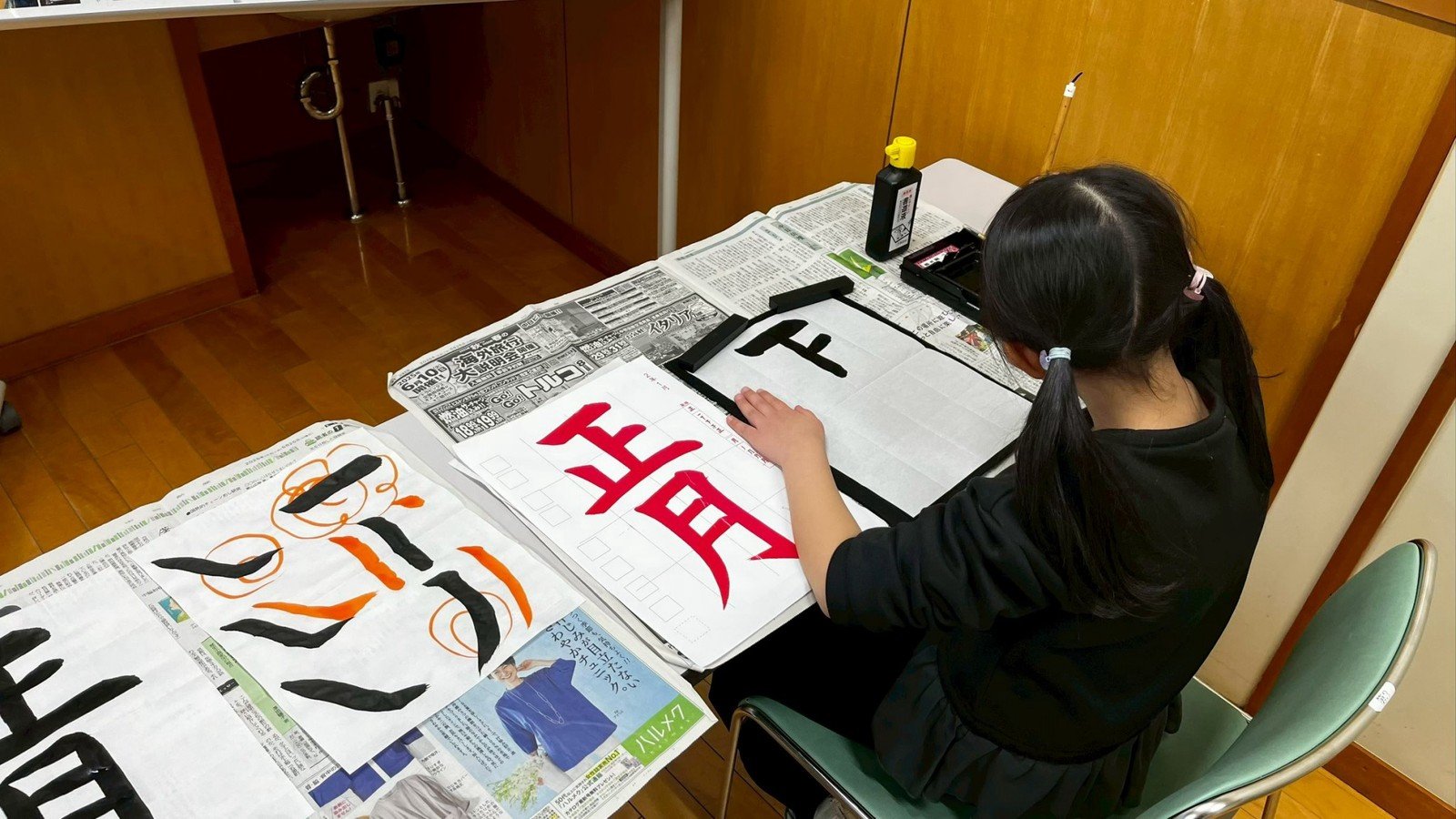
Many children also go to a calligraphy class once a week after school. Our school, Kodomo School, in Toyohashi, has taught children this way since 1976.
Each month the students copy a new model and submit their best sheet, moving up through numbered grades (kyu) and then ranks (dan), much as in judo or the abacus. The red corrections on a practice sheet are the teacher’s hand.
Contests and exhibitions 競書大会
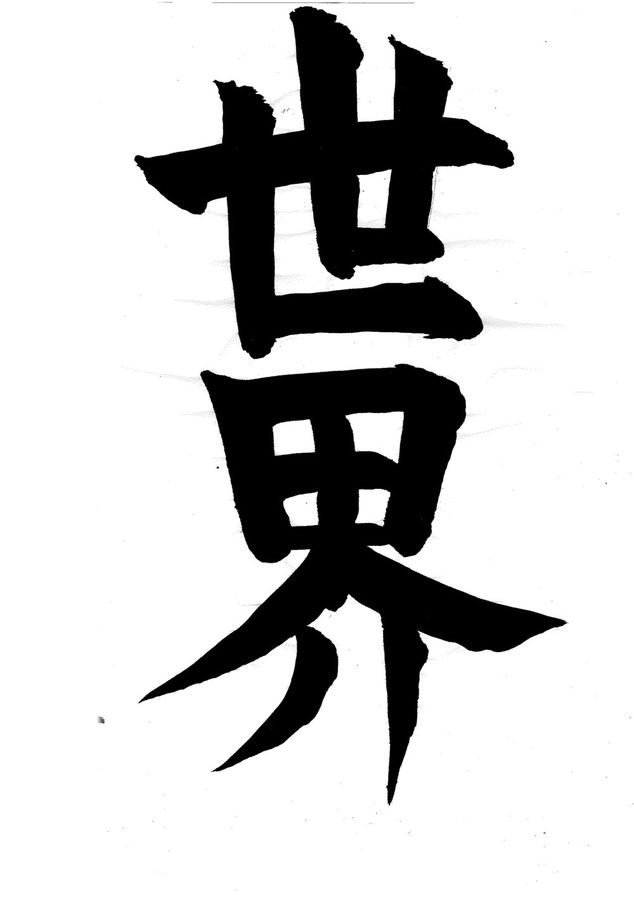
Calligraphy contests, kyosho taikai, run all year. Schools send work to national contests, such as the one run by JA Kyosai, the farm cooperatives’ insurance arm, which held its 69th edition in 2025. Cities and prefectures hold kakizome exhibitions each January with a set word for every grade: Saitama Prefecture’s 2024 exhibition gave third graders せかい (“the world”) and sixth graders 自然の美 (“the beauty of nature”).
Okazaki, next door to Toyohashi, has held a kakizome exhibition for its schoolchildren every January for decades, and our school holds a calligraphy contest of its own each January. The best-known event is at the Nippon Budokan in Tokyo on January 5, where several thousand people, from preschoolers to adults, write their assigned phrase at the same time.
Life’s milestones
A baby’s name sheet 命名書
On the seventh night after a baby is born, the family celebrates oshichiya and announces the name. It is written with a brush on a sheet of thick white paper, the meimeisho: the word 命名 (“naming”), the baby’s name, and the date of birth.
The sheet is placed by the family altar or in the alcove of the main room, often for about a month, until the baby’s first visit to a shrine. It is usually written by a parent, though some families ask a calligrapher.
Gift envelopes のし袋
Money for a wedding, a birth, or a funeral is never handed over bare. It goes in a special envelope, and the purpose is written on the front with a brush or brush pen. This front writing is the omotegaki, and it is the piece of brush writing adults meet most often.
Celebrations祝儀袋shugibukuro
For a wedding, 寿 (kotobuki, “felicitations”) or 御祝 (“congratulations”), with your full name below. Dark black ink, in clear kaisho, the standard script. A ballpoint pen is considered rude.
Condolences不祝儀袋bushugibukuro
For a funeral, 御霊前 (“before the spirit”) in pale gray ink, usuzumi. The custom says the ink is thin because tears fell into it, or because you rushed to the house without time to grind it properly.
The wedding guestbook 芳名帳
At the reception desk of a wedding, each guest writes their name and address in the homeicho, the guestbook. The traditional one is a vertical book, written with a brush pen, and your name in brush script is the first thing the couple’s families see of you.
Certificates and diplomas 賞状・卒業証書
Award certificates and graduation diplomas are handed over one by one at ceremonies, and the recipient’s name is often lettered by hand. This is the work of professional calligraphers called hikko, who write clean, standard characters for certificates, invitations, and place cards, a trade separate from calligraphy as art.
Temples and shrines
Goshuin 御朱印
Visitors to a temple or shrine can receive a goshuin: red seals pressed onto a page, with the name of the temple and the date written over them in ink by a priest or staff member. Originally it was proof that you had offered a hand-copied sutra; today it is a record of your visit.
People collect them in a dedicated accordion-folded book, and collecting goshuin has been a popular hobby since the mid-2010s.
Sutra copying 写経
Shakyo is copying a Buddhist sutra by hand, usually the Heart Sutra, and it is one of the oldest uses of the brush in Japan: in the 8th century the state ran copying offices that produced sutras in great numbers. The purpose was to preserve the texts and to earn spiritual merit.
Today many temples have a hall where anyone can sit and copy a sutra, tracing a model placed under the paper. Yakushiji in Nara began its copying program in 1968, and its hall seats a hundred people at a time.
Around town
Signs, labels, and menus
Walk down any shopping street and you will see brush writing on shop signs, on the split curtains over restaurant doors, on menus, and on festival banners. Brush lettering feels warm, traditional, and strong, so shops use it where a printed font would feel cold.
Sake labels are a special case: breweries commission a calligrapher to write the name of the sake, and a label can be as collectible as the bottle. In 2026 a project set out to pair one calligrapher with a brewery in each of Japan’s 47 prefectures to write their labels.
Titles of films and TV dramas 題字
The title lettering of a film or drama, the daiji, is often commissioned from a calligrapher. NHK’s year-long historical dramas have done this for years, including the 2024 series about the author of The Tale of Genji, and the calligrapher sometimes coaches the actors as well.
Try it now
Write a thank-you card the Japanese way.
感謝 (kansha, gratitude) is the word people write on thank-you cards. Print the sheet, write it a few times on hanshi, and tuck your best one into a card.
Questions
Do Japanese people still use calligraphy in daily life?
Yes. Every child learns brush writing at school from third grade, families write kakizome at New Year, and adults write with a brush or brush pen on gift envelopes, New Year cards, a baby’s name sheet, and the guestbook at a wedding. Shop signs, sake labels, and film titles are often brush-written too.
What do Japanese people write at New Year?
A word or phrase for the year ahead, written with a brush on January 2. Children write a word set by their school, such as 新春 (new spring) or 初日の出 (the first sunrise). Adults often write a four-character idiom that sums up a goal for the year.
Why is the writing on a Japanese funeral envelope gray?
Condolence envelopes are written in pale ink, usuzumi. The custom says the ink is thin because tears fell into it, or because the writer hurried to the mourning house without time to grind the ink. Envelopes for weddings and other celebrations use dark black ink, and using pale ink on them is a serious mistake.