
The benefits of soroban
Soroban builds
a strong sense of self.
Calculation and concentration as “visible skills.” Confidence and perseverance as “invisible strengths.” Soroban (the Japanese abacus) is about much more than faster calculation.

We believe soroban is the ideal training for building what Kodomo School values most: the strength to live true to yourself. Below, we introduce what soroban builds in two parts, following Kodomo School’s philosophy: “visible skills” and “invisible strengths.”


Visible skills
Real skills you can clearly see
Soroban trains the whole brain in a balanced way and builds solid skills.
① Balanced brain training (left and right brain working together)
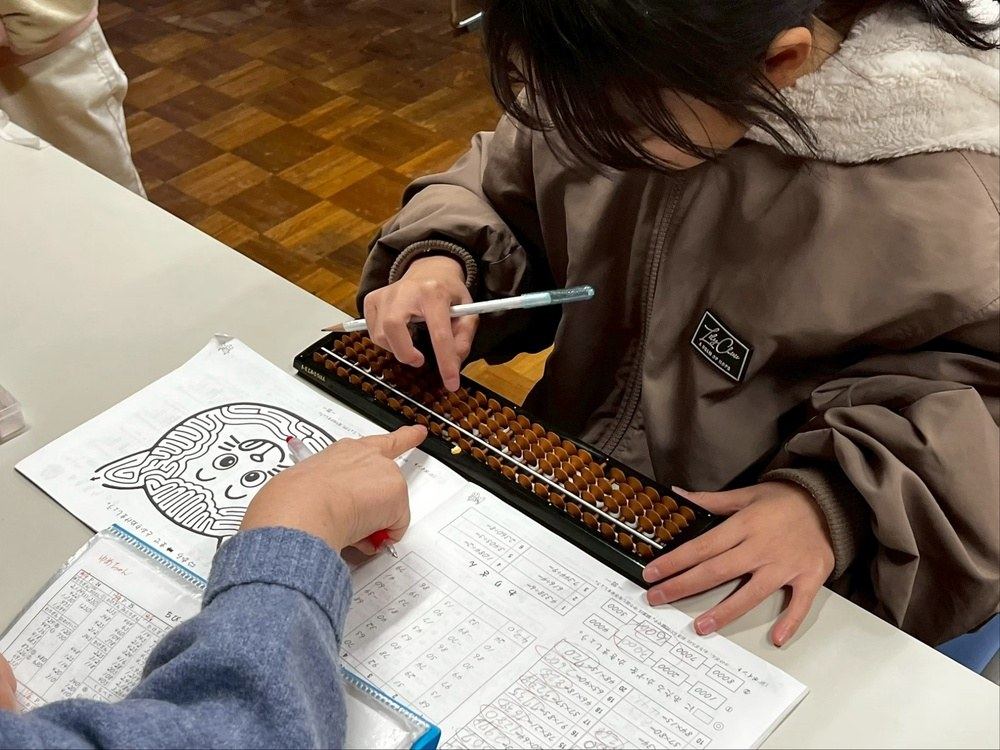
Children use their fingertips to move the beads (tama) logically and calculate.
With practice, children learn soroban-style mental math (anzan), picturing a soroban in their mind, and the right brain really gets to work.
Using the right and left brain at the same time is what builds the foundation of strong natural thinking ability.
② Deep concentration and calculation skills
By practicing again and again to find correct answers within a time limit, children build a habit of deep focus that also helps with other studies and sports.
Invisible strengths
The strengths we most want to nurture
What Kodomo School most wants to grow through soroban is “invisible strengths.”
- Self-esteem (the confidence that “if I try, I can do it”)
Learning soroban is a chain of small successes: “I did it!” “I passed!” Overcoming these small steps through their own effort builds a real confidence: “I’m okay” and “if I try, I can do it.”
- Perseverance and judgment
“Perseverance” to keep practicing steadily toward a goal (passing an exam). “Judgment” to read numbers in an instant and choose the best finger movements. These become an inner anchor that supports children when they face difficulties in the future.
- Intuition and creativity
As the right brain is trained, children not only get good with numbers but also develop “intuition” to grasp the heart of things and “creativity” to come up with new ideas.
Click-clack, flick the beads,
and let’s collect more “I did it!” moments.

Start with a free trial lesson
Soroban and calligraphy trial lessons are free (about 20 minutes; just bring something to write with). The art trial lesson is 40 minutes and costs ¥1,000 (nothing to bring). Come with your child and see the feel of the classroom and how well the teacher suits your child.