
Shodo / Learn 入門
Learn Japanese calligraphy, step by step
A free guide in 17 lessons: what shodo is and where it came from, when Japanese people write with a brush, the tools, and how to write your first characters. It follows the path our students in Japan follow, written for adults learning on their own. No Japanese needed.
- 17 lessonsin four parts: discover, get ready, write, keep going
- Free to readno sign-up. Our book covers the hands-on lessons in print, with 16 model words to copy
- Brushed by our teachersevery character here is handwritten, not a font
Part 1
Discover shodo
What shodo is, where it came from, when Japanese people write with a brush, and how children learn it.
- 01What is shodo?Shodo is Japanese calligraphy: characters written with a soft brush and black ink. Its name means "the way of writing," and the word "way" says a lot.6 min
- 02A history of Japanese calligraphyJapanese calligraphy grew out of Chinese characters and became an art of its own. Follow 1,200 years of shodo, from Kukai's letters to kakizome today.12 min
- 03When do Japanese people write with a brush?Brush writing is still part of ordinary life in Japan.7 min
- 04Kakizome: New Year calligraphyKakizome is Japan's first calligraphy of the year, written on January 2.7 min
- 05The five scriptsThe same character can be written in five classic scripts, plus kana.4 min
- 06How children learn calligraphy in JapanIn Japan, calligraphy is learned from a teacher: a model to copy, corrections in red, and another try. The same simple cycle, week after week.5 min
Part 2
Get ready
The tools you need, how to choose a brush, where to buy in the U.S., and how to set up your space.
- 07The tools: the four treasuresJapanese calligraphy (shodo) uses four basic tools: brush, ink, inkstone, and paper, plus a few helpers.6 min
- 08Choosing your first brush, and where to buyYou need one good large brush, and later a small one for your name. Here is what to look for, how to prepare a new brush, and where to buy in the U.S.6 min
- 09Setting up your spaceA tidy, well-arranged desk makes writing easier and cleanup faster.4 min
Part 3
Write
Posture, ink, the strokes, your first characters, and a whole word on hanshi.
- 10Posture and how to hold the brushHow to sit and how to hold a Japanese calligraphy brush: upright, from the arm, with a little space in the hand.5 min
- 11Ink and loading the brushHow much ink is on your brush changes everything. Too much spreads into blots; too little breaks into dry, scratchy lines.4 min
- 12The strokesEvery stroke has an entry, a travel, and an ending, and almost any character can be built from eight movements.7 min
- 13Your first charactersEight simple characters, written by our teachers, to put the strokes together. The red numbers show the stroke order, placed where each stroke begins.5 min
- 14Writing a word on hanshiTwo characters, top to bottom on one sheet of hanshi, with your name on the left: the standard practice format in Japan. Here is how to lay it out.5 min
Part 4
Keep going
Fixing common problems, caring for your tools, and what comes next.
- 15Common problems and fixesEvery beginner runs into the same few problems. Here are the ten our teachers see most often, with the usual cause and the fix for each one.5 min
- 16Cleaning up and caring for your toolsA brush washed and dried well keeps its point for years. One left with ink in it can be ruined in days. Take five minutes at the end of every session.4 min
- 17Next stepsOnce the model words feel comfortable, there are many directions to explore. Here are a few ideas to keep your practice fresh and enjoyable.4 min
Reference
Reference
Words to know, with their Japanese characters and a pronunciation guide.
How to use this guide
Read first, then gather your tools, then write.
Part 1 is for reading: what shodo is, its history, and where you meet it in Japanese life. Part 2 helps you gather your tools. When your supplies arrive, work through Part 3 in order, because each lesson builds on the one before it. Part 4 helps you keep going once the first excitement has passed.
Our family runs Kodomo School, a group of after-school classrooms in central Japan, based in the city of Toyohashi. The school began in 1976, and today our teachers teach abacus, handwriting and brush calligraphy, and art to children. The way they learn is simple and patient: straight lines first, then how to sit and hold the brush, then a model written by a teacher, corrected in red, and tried again. This guide follows the same path.
All of the brush characters in this guide were written by hand by the calligraphy teachers of Kodomo School. We did not use computer fonts for any of the models, because the small details of a real brush stroke, where it presses down and where it lifts away, are exactly what you are learning to see.
Japanese words are written in the Latin alphabet without long-vowel marks, so you will see shodo rather than shodō. The glossary shows each word with its Japanese characters and a simple pronunciation guide.
While the sets are on their way
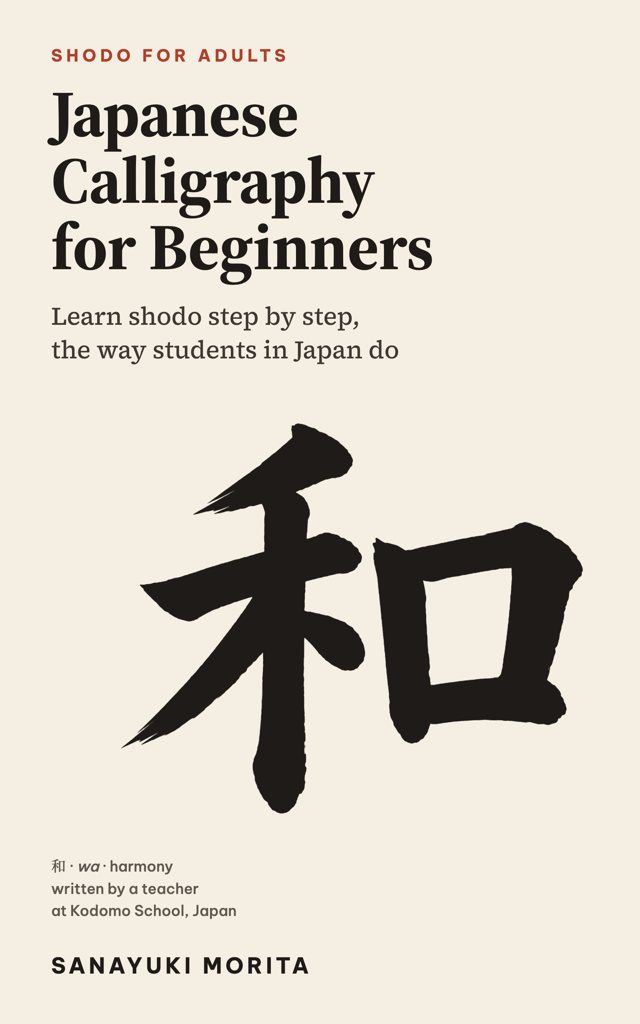
The book is out now.
Japanese Calligraphy for Beginners takes you from holding the brush to writing whole words, step by step, in English. Every model inside was brushed by our teachers.
Starter Set, $72.99 with the book, brush, ink and paper: coming soon.