
Lectures & Seminars by Our Founder
“Free people from their invisible limits
and let their talents bloom”
Awakening self-esteem and human strength, drawn from real experience in education, business and global work. Here you can learn about lectures and training by Taito Morita, founder & principal of Kodomo School.

A specialist in developing people who “frees people from their invisible limits and lets their talents bloom”
Taito Morita森田 泰斗
- President & CEO, Morita Group Co., Ltd. / Founder & principal, Kodomo School
- Representative Director, Association for the Promotion of Traditional Education in Local Communities (general incorporated association)
- President & CEO, Morita Group Vietnam JSC.
Profile
Born in Toyohashi, Aichi Prefecture. An educator and business owner who, for more than 30 years, has kept watching for “the moment a person grows and begins to shine” — both in the classroom and in business.
He ran the cram school 森田塾 (Morita Juku) in Toyohashi, expanding it to several locations over more than ten years. He then founded Kodomo School, which offers soroban (Japanese abacus) and Japanese calligraphy & handwriting (kakikata shodo) classes, mainly in Aichi and Shizuoka Prefectures. Today Kodomo School runs about 100 directly managed classrooms. It aims for more than just building skills: above all, it treasures the joy of “I did it!” that children feel through soroban and calligraphy. By adding up these small successes, the school puts into practice an education that nurtures children’s self-esteem (a sense of “I can do it”).
This philosophy also guides how teachers are trained. For more than ten years, he has led practical training in which teachers learn to accept themselves, enjoy their own growth, and “lead the students and parents in front of them to happiness.” In this way he has built “an organizational culture where people keep growing on their own.”
He has also opened a Japanese-style soroban school in Hanoi, Vietnam, spreading education that builds “the power to believe in yourself” to the wider world. In recent years he has expanded his work to “philosophy dialogue for children,” nurturing self-esteem by helping children “think for themselves, express their ideas, and understand diversity.” Drawing on his experience in Japan and abroad, he also teaches classes on the theme of multicultural coexistence. He is passionate about education that crosses the borders of countries and generations, helping people think for themselves and grow beyond their limits.


Core philosophy
Freeing people from their “invisible limits”
Morita’s goal is to free people from the “invisible limits” that hold back their own potential.
Parents, schools, society and culture unconsciously shape our “frames of values.” These frames can lock away a person’s talent, while we never notice that they are only an illusion. Morita is convinced that removing these frames, so that “everyone notices their own talents and begins to shine,” leads to a happy and harmonious society. He continues to create opportunities for this kind of “awareness.”
What makes the lectures and training different
Change through “experience” and “awareness”
Hands-on workshops
This is not a one-way lecture. Along with real-life stories, participants “experience” things for themselves.
Dialogue (philosophy dialogue)
Sessions are designed so that participants “share and empathize” with others and “notice” things from within. “Not over-teaching” is what helps people grow.
Action from tomorrow
Beyond learning theory, participants are encouraged toward concrete changes in behavior they can practice from tomorrow, and toward a wider view, a higher viewpoint and greater awareness.
Participants have shared many responses about experiences that moved their hearts in a positive direction, such as “The theory was easy to understand and practical,” “His heartfelt words brought me to tears,” and “It reminded me of the starting point of education and developing people.”
Main lecture and training themes
Every program can be customized to your needs
Core theme
“The skill of removing the ‘invisible limits’ inside you”
Why do people close off their own potential? A method for changing your mindset so your talents can bloom (workshop)
Organizations & people development
“Developing people through ‘awareness’ to build a self-growing organization”
The key is “not over-teaching.” Ways of engaging that dramatically raise the self-esteem of employees and children
Management & teams
“Team building that grows self-esteem”
How to build the “trust” that brings an organization to life, through thoughtful ways of praising and correcting
Thinking & sensibility
“Human strength for the AI age, opened up by inspiration and intuition”
New ways of working and living that use “sensibility” and the “right brain,” beyond logic
Education & parents
“Right-brain education that nurtures children’s self-esteem”
Lessons from teaching soroban: words that draw out a child’s “I did it!”
Diversity & global
“Diversity and a way of life that respects people”
Multicultural coexistence and building trust — lessons from a childhood in the United States and educational work in Vietnam
Education (for parents, PTAs and educators)
- “I did it!” changes the future — education that nurtures children’s self-esteemSmall successes can greatly change a child’s confidence and life. The Morita approach to education that nurtures the heart.
- The moment people grow — the educational power of “believing”People don’t grow because they are taught; they grow because they are believed in. A talk on the starting point of education and developing people.
- Thinking and expressing skills nurtured by philosophy dialogue for childrenThinking skills and self-esteem grow as children talk together about “questions with no right answer.” A new form of dialogue spreading in schools.
- Happy parenting — parent–child relationships that build confidence and courageWhat helps children grow is not special education but everyday words. When parents change, children change.
- The “power to believe” that shapes the future — how to nurture self-esteem that changes both children and adultsWhen we draw out the “power to believe” that everyone naturally has, both children and adults begin to change. A talk on how self-esteem changes our lives, and concrete ways to nurture it.
Business (for business owners, HR staff and businesspeople)
- A new approach to developing people, built on the right brain and compassionWhat the AI age truly calls for is not logic but “sensibility” and “empathy.” The essence of developing people, learned from right-brain education.
- Living in the times ahead, guided by inspiration and intuitionTo get through unpredictable times, what we need is not knowledge but the “ability to sense.” How to trust your own sensibility.
- The courage not to over-teach — people and organizations that keep growing on their ownBeyond results-based management lies “education that believes and entrusts.” Ways of engaging that develop people who think and act for themselves.
- Right-brain thinking changes everything! Work skills and creativity for the AI ageFlexibility over precision, intuition over logic. Tips for new ways of working that use the power of the right brain.
International (for those interested in multicultural and global themes)
- Multicultural coexistence — education that connects people across countries and generationsLearning that turns “differences” into strength, seen through his work as a bridge between Vietnam and Japan.
- What it means to “work together” with foreign talent — workplaces where people grow among many culturesAn attitude of “learning together” rather than “teaching” creates trust and growth. Hints for an age of “working together,” from his experience of growing alongside Vietnamese staff.
- The courage to accept differences, the kindness to communicate — new strengths for Japanese people, nurtured by multicultural coexistenceCultural differences are not walls but doorways to learning. The importance of “speaking” and “listening,” learned through exchanges with young people in Vietnam.


Message
People change dramatically
when someone believes in them.
At the root of both education and people development is “trust in people.” More than knowledge, what matters is how we nurture the heart. More than efficiency, what matters is how deeply we can believe in another person’s potential.
In my lectures and training, I share real experiences from the classroom and practical examples from companies. Through hands-on work, I create together with you the “decisive moment” when people remove their limits, believe in their own strength and move forward.
Books
Books by our founder

「ひらめきと直感力を鍛える本」
(Training Your Inspiration and Intuition)
同文舘出版 (Dobunkan Shuppan)
In an age overflowing with information, this book shows why it matters to polish not only knowledge but also “wisdom” and “sensibility.”
Read more
In an age overflowing with information, this book shows why it matters to polish not only knowledge but also “wisdom” and “sensibility.” Drawing on his own varied career as a systems engineer, an art dealer and an educator, Morita explains how to open up “a world that logic alone cannot see.”
The book introduces practical training for drawing out the “inspiration” and “intuition” that everyone has, along with tips for using the subconscious mind. It is full of hints for boosting creativity in business, education and daily life, and for living a rich and fulfilling life.
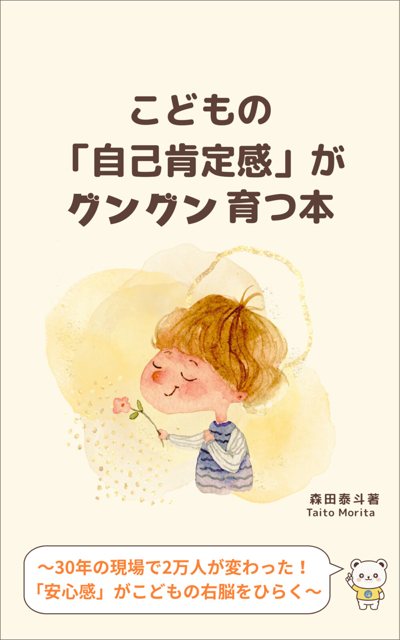
「こどもの「自己肯定感」がグングン育つ本」
(A Book That Helps Children’s Self-Esteem Grow by Leaps and Bounds)
— 20,000 children changed over 30 years in the classroom! A sense of security opens up a child’s right brain —
“Why does my child have so little confidence…?” For mothers and fathers with this worry, a book that helps self-esteem grow naturally.
Read more
The author has watched more than 20,000 children reach their “moment of growth” through soroban, calligraphy, art and philosophy dialogue for children. This book brings that experience together to help self-esteem grow naturally.
Today’s elementary school children live with pressures that give their hearts no rest: being compared with others, fatigue from social media, and the strain of feeling they must always “be a good kid.” Through gentle stories, the book explains the real reasons children lose confidence, and the changes that happen when their hearts feel safe again.
Before a child starts to grow, there is always a small flash of insight: “I think I sort of get it.” This is a sign that the right brain is opening. When the right brain opens, the child’s face softens, their breathing calms, their will to try comes back, and they stop putting themselves down.
Soroban, calligraphy, art and philosophy dialogue are not subjects that need special talent. They are “classrooms for the heart” that naturally create experiences of safety, freedom, small successes and thinking for yourself. These become the foundation of a child’s confidence. The book also introduces many methods you can try at home starting today, such as “one reassuring word,” “five minutes of quiet time,” “listening without judging” and “Wakuma’s gentle questions.”
Every child has the power to grow. There is not a single child who cannot grow — only the “timing” is different. I hope this book helps you feel at ease and think, “My child is fine. They are just growing at their own pace.”
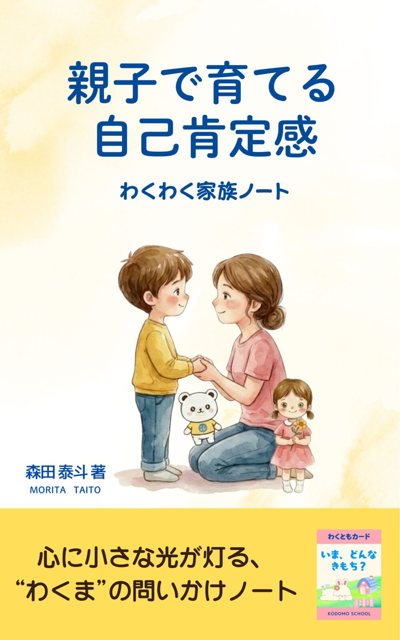
「親子で育てる自己肯定感 わくわく家族ノート」
(Growing Self-Esteem Together as Parent and Child: The Waku-Waku Family Notebook)
A notebook of questions from Wakuma that lights a small light in your heart
“I ended up speaking too harshly.” “I don’t know how to face my child.” This book stays close to parents who feel this way. The guide through the story is Wakuma, a teddy bear.
Read more
A morning when you got angry, an evening when you felt low, a night with feelings you couldn’t put into words. In those moments, Wakuma gently asks, “Hey, how are you feeling right now?” With that one question, a small “light of awareness” begins to glow in the family.
- Mom: notices the “worry” hidden beneath her anger
- そら (Sora): learns that even on days when things don’t go well, there is still something to “love”
- Dad: realizes that behind his silence were “feelings he couldn’t put into words”
- なな (Nana): finds the “courage” to trust the colors she feels
Simply by reading on, the feelings of both parents and children gently soften. At the end of the book you’ll also find questions from the “Wakutomo Cards” that the whole family can use, so you can take home “conversation starters” to try at home from today.
Your home already holds “seeds of light.” Wakuma is there to help you notice that light.
Booking a lecture or seminar
How to book
- Contact usPlease reach us through the inquiry form or by phone. Phone: 090-8031-1486
- Consultation & proposalWe will listen to your needs and propose a program. *There is no charge for consultations or proposals.
- ApplicationWe will send you an application form and a confirmation sheet by email or post. Please fill in the required details and send them back to us.
- Lecture / seminarWe will give it our all so that everyone is satisfied.
- Follow-upWe will look back on how participants responded and give advice for further growth.
Inquiry form